Most agencies finish the logo and move on. Some organizations need something different. A studio that stays, learns the ecosystem, becomes fluent in the brand, and helps govern it over time. That is what an embedded creative partner looks like.
The work rarely ends at a deliverable. For institutions with ongoing creative needs, it continues across campaigns, departments, and a public face that never stops evolving.
This is what it looks like inside MRC’s ongoing partnership with Research Triangle Park.
The Brief: Civic Branding at Institutional Scale
Research Triangle Park is one of the most established innovation ecosystems in the United States. A 65-year-old global research hub with a deeply complex organizational structure, multiple entities, and a mission that now extends far beyond office parks and corporate campuses.
It is evolving again.
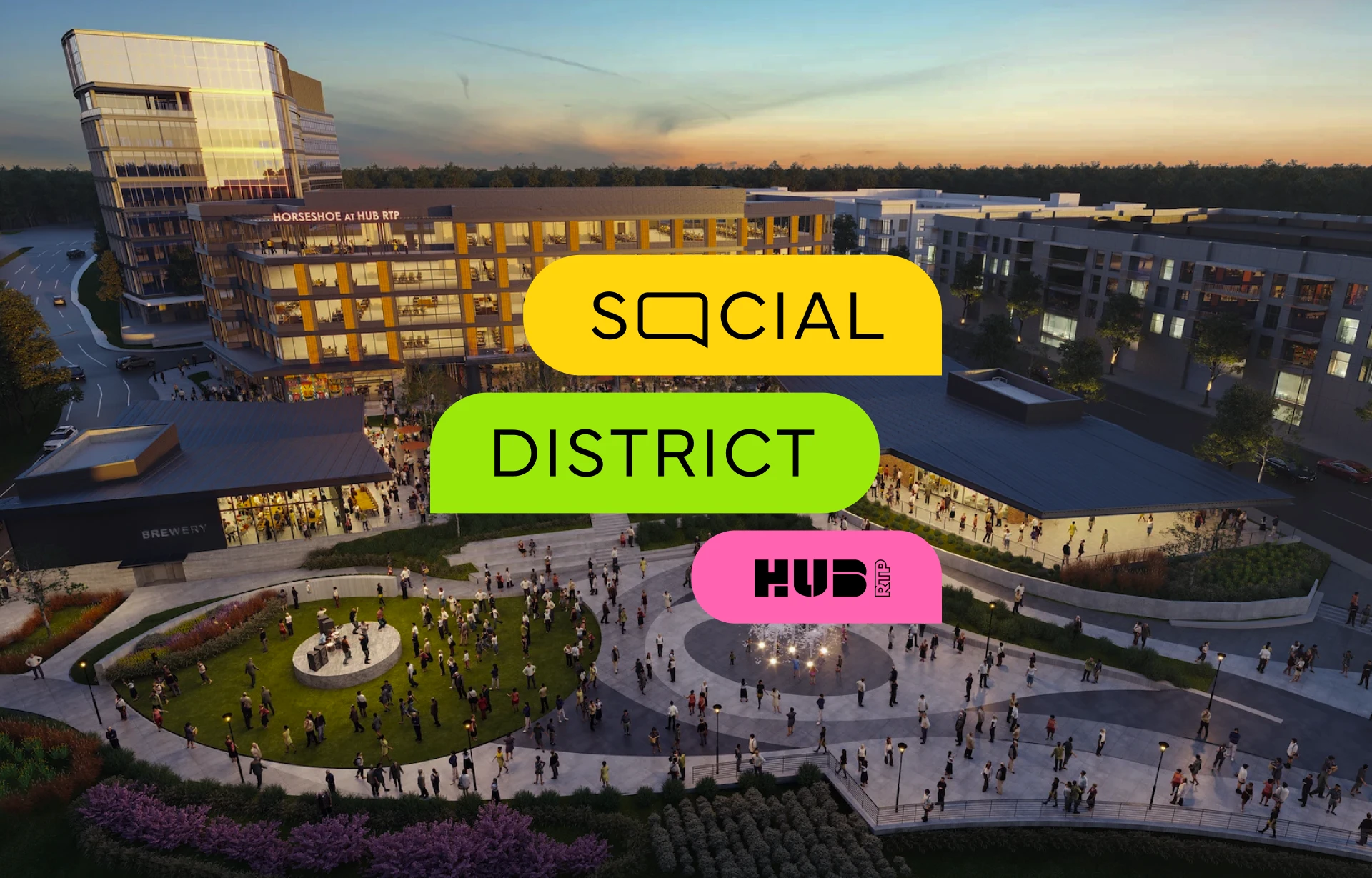
A new social district is forming. Residential integration is reshaping how people experience the space. A new generation of talent is being recruited into a civic and innovation ecosystem that was not originally designed for public life in its current form.
The challenge was not simply visual identity or a new logo. It was institutional brand identity at scale. More specifically, it was brand governance across an entire ecosystem of entities, stakeholders, and audiences that all needed to feel connected without becoming visually or operationally rigid.
When MRC first stepped into conversations with RTP, the shift in scope was immediate. This was not a standard branding project. It was a long-term creative partnership rooted in civic branding and ecosystem-level brand systems.
What stood out in that first conversation was not just what needed to be designed. It was how many departments, initiatives, and future-facing programs the brand needed to support without fragmentation.
What Is Brand Governance?
Brand governance is the operational system behind institutional brand identity. It is one of the most important but least understood parts of an embedded creative partnership.
It is not only about visual consistency. It is about how brand decisions get made across a complex organization.
In a civic branding environment like Research Triangle Park, brand governance means auditing every existing expression of the brand across entities, departments, programs, and public initiatives. The goal is not to eliminate variation, but to bring structure to it.
From there, the system is built. A framework is created that allows for multiple expressions, social districts, programming arms, and institutional initiatives, while still operating under one cohesive brand identity system. The goal is not uniformity. The goal is clarity, legibility, and brand recognition across touchpoints.
This requires creating standards that internal teams can actually use in practice. Not theoretical guidelines, but operational brand systems that support real decision-making across marketing, events, partnerships, and communications.
This is where an ongoing creative partnership becomes essential. Brand governance is not a one-time deliverable. It is a continuous system that evolves alongside the organization.
For MRC, this distinction is fundamental. Design defines the brand system. Governance sustains it over time.

What Does an Embedded Creative Partnership Look Like in Practice?
The partnership with Research Triangle Park has moved across multiple layers of the ecosystem, from institutional brand strategy into ongoing creative execution.
A new social district identity is in development, designed to support a growing public-facing layer of RTP. This includes a shift toward more civic-facing branding and experiential design that connects people to place in a more immediate way.
Alongside this, MRC supports ongoing creative strategy and execution across digital campaigns, event programming systems, and design support that extends the brand into real-world activation. That includes social district branding in development for rollout this fall, civic branding systems supporting programming and public events, ongoing campaign design across multiple internal departments, and flexible creative production across institutional and public-facing needs.
What makes this different from traditional agency work is not the volume of output. It is the continuity of the embedded creative partner relationship. Every new piece of work builds on existing institutional knowledge because the partnership is ongoing, not project-based. The system stays intact because the creative partner stays engaged.
What Makes an Embedded Creative Partnership Work?
An embedded creative partnership is not defined by scope. It is defined by continuity.
Trust is not assumed at kickoff. It is built through repeated alignment across real institutional constraints and evolving organizational needs.
In complex civic branding environments like RTP, this requires understanding internal dynamics that are not visible in a creative brief. It means knowing how departments interact, how approvals flow, and where institutional friction tends to appear.
An embedded creative partner must operate with two modes of thinking at once. Knowing when to expand the system and evolve the brand. Knowing when to reinforce structure and protect institutional consistency.
Clear communication structures are essential. Without them, even strong creative work loses coherence at scale.
Over time, something important happens. The studio stops functioning as an external vendor and becomes part of the organization’s creative infrastructure. Not internal staff. Not a traditional agency. An embedded creative partner within the system. That is what enables long-term brand governance and sustained institutional brand identity.
Do You Need an Embedded Creative Partner?
Not every organization needs an ongoing creative partnership. But for many institutions, civic organizations, and multi-entity brands, the traditional agency model no longer holds.
An embedded creative partnership becomes relevant when your organization has ongoing creative needs that exceed what a single in-house designer or rotating set of vendors can sustainably manage. When multiple departments, programs, or public-facing initiatives all require consistent but flexible brand expression. When you are no longer focused on launching a brand but on maintaining and evolving an institutional brand identity over time. And when you need a creative strategy partner who is actively engaged in how the brand operates, not just how it looks.
At that point, the question is not whether you need design support. It is whether you need an embedded creative partner who understands the system well enough to help govern it.
Looking for a creative partner that stays invested beyond the deliverable? Let us talk about what an ongoing creative partnership with MRC looks like, and how brand governance can support your organization as it evolves.